In the last edition, we talked about why 50-50 equity splits are dangerous. Today, let’s talk about the solution.
We call it the “Founder Prenup.” In legal terms, it’s a Shareholders’ Agreement (SHA) with specific founder-protection clauses.
Most founders think an SHA is just a document investors force you to sign during funding. Wrong. You need an SHA the day you incorporate—even if it’s just you and your best friend.
Why? Because when things go wrong (and they will), you cannot rely on friendship. You need a contract.
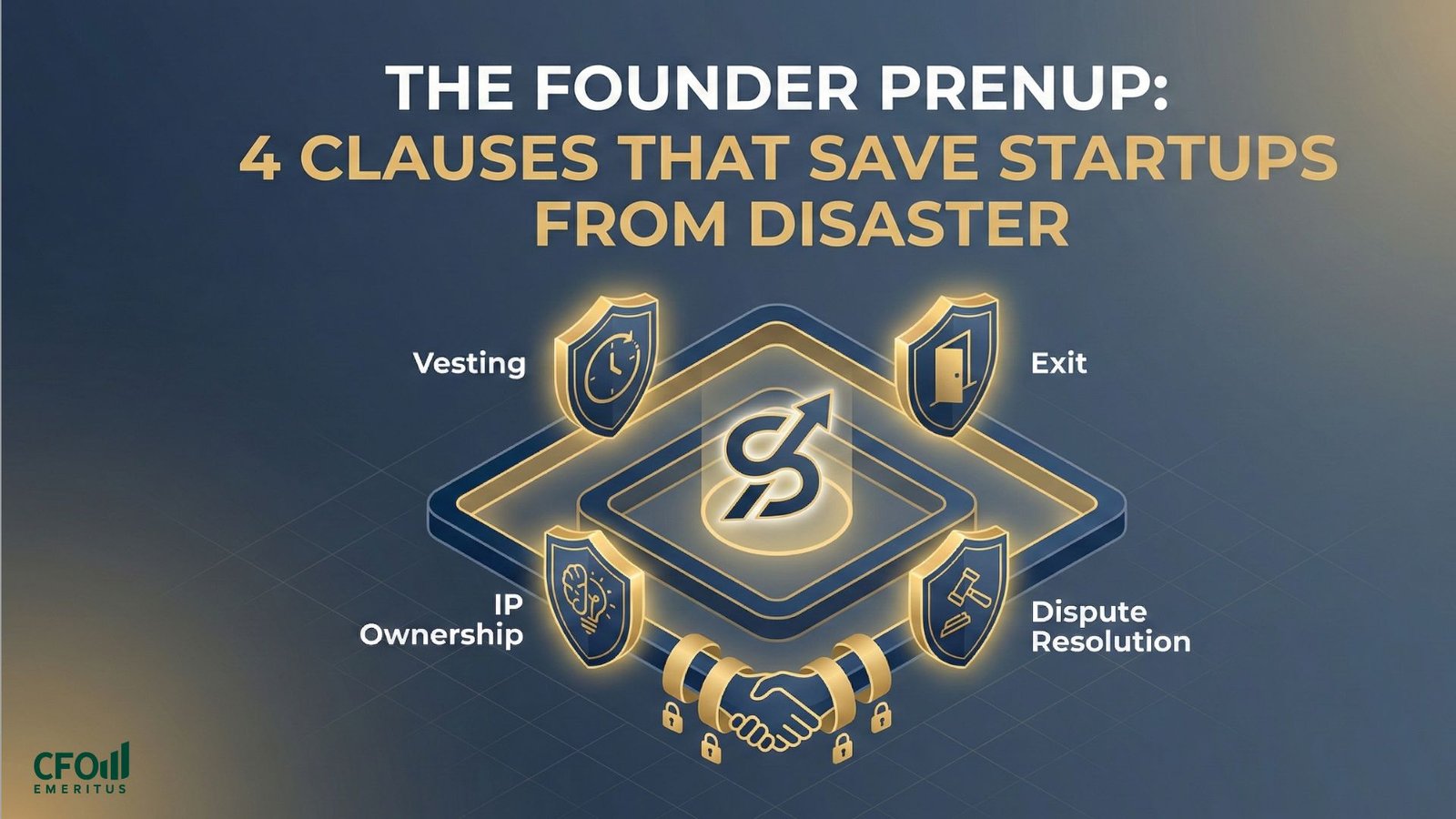
Here are the 4 critical clauses we at CFO Emeritus ensure every “Founder Prenup” includes to protect the business.
⏳ 1. Reverse Vesting (The “Earn It” Clause)
Standard vesting says: “You get shares later.” Reverse vesting says: “You get shares now, but the company has the right to take them back if you leave early.”
How it works: You might legally hold 50% of the shares today. But if you leave in Year 1, the company has the right to buy back 100% of those shares at a nominal price (e.g., ₹10). Every month you stay, the company loses the right to buy back a small portion. This ensures no one walks away with half the company after doing 2 months of work.
😈 2. The “Bad Leaver” Provision (The “Eject” Button)
Not all departures are equal. If a co-founder leaves because of a severe illness, they are a “Good Leaver.” They might keep some equity.
But what if they commit fraud? Or join a direct competitor? Or just stop showing up? That makes them a “Bad Leaver.”
The Clause: A Bad Leaver is forced to sell their shares back to the company—usually at Face Value (dirt cheap) rather than Fair Market Value. This prevents a toxic co-founder from profiting off your future hard work.
🧠 3. IP Assignment (The “Who Owns the Code?” Clause)
This is the most common mistake in tech startups. A CTO writes the code on their personal laptop. Then they leave. They claim: “I wrote the code, so I own it. You can’t use it.”
The Clause: An Intellectual Property (IP) Assignment clause states that everything created during the business—code, designs, client lists, branding—belongs to the Company, not the Individual. Without this, your startup is un-investable because you don’t technically own your product.
🔫 4. The “Shotgun” Clause (The Clean Divorce)
What happens when 50-50 partners disagree on a major decision and reach a deadlock? The business freezes.
The Clause: The Shotgun Clause is a brutal but effective tie-breaker. Partner A can offer to buy Partner B’s shares at a specific price (say, ₹100 per share). Partner B then has two choices:
-
Sell their shares to A at ₹100.
-
Buy A’s shares at ₹100.
This ensures a fair price (because if you offer too low, you might get bought out yourself!) and guarantees a clean exit for one party.
🎯 Final Thought
A Founder Prenup isn’t about planning for failure. It’s about removing the fear of failure.
When you know exactly what happens if things go wrong, you can focus 100% of your energy on making things go right.
At CFO Emeritus, we don’t just handle your accounts; we help structure your partnership so it survives the hard times.
📩 Need to draft a Founder Prenup? Don’t wait for the first fight. Let’s structure it now. Write to us at office@cfoemeritus.com