The most dangerous moment for a startup isn’t when it runs out of cash. It’s the moment two friends sit in a coffee shop, shake hands, and say:
“We’re partners. Let’s split it 50-50.”
Recently, a founder came to us at CFO Emeritus with what he thought was a “fundraising problem.” He had a great product, early traction, and interest from investors.
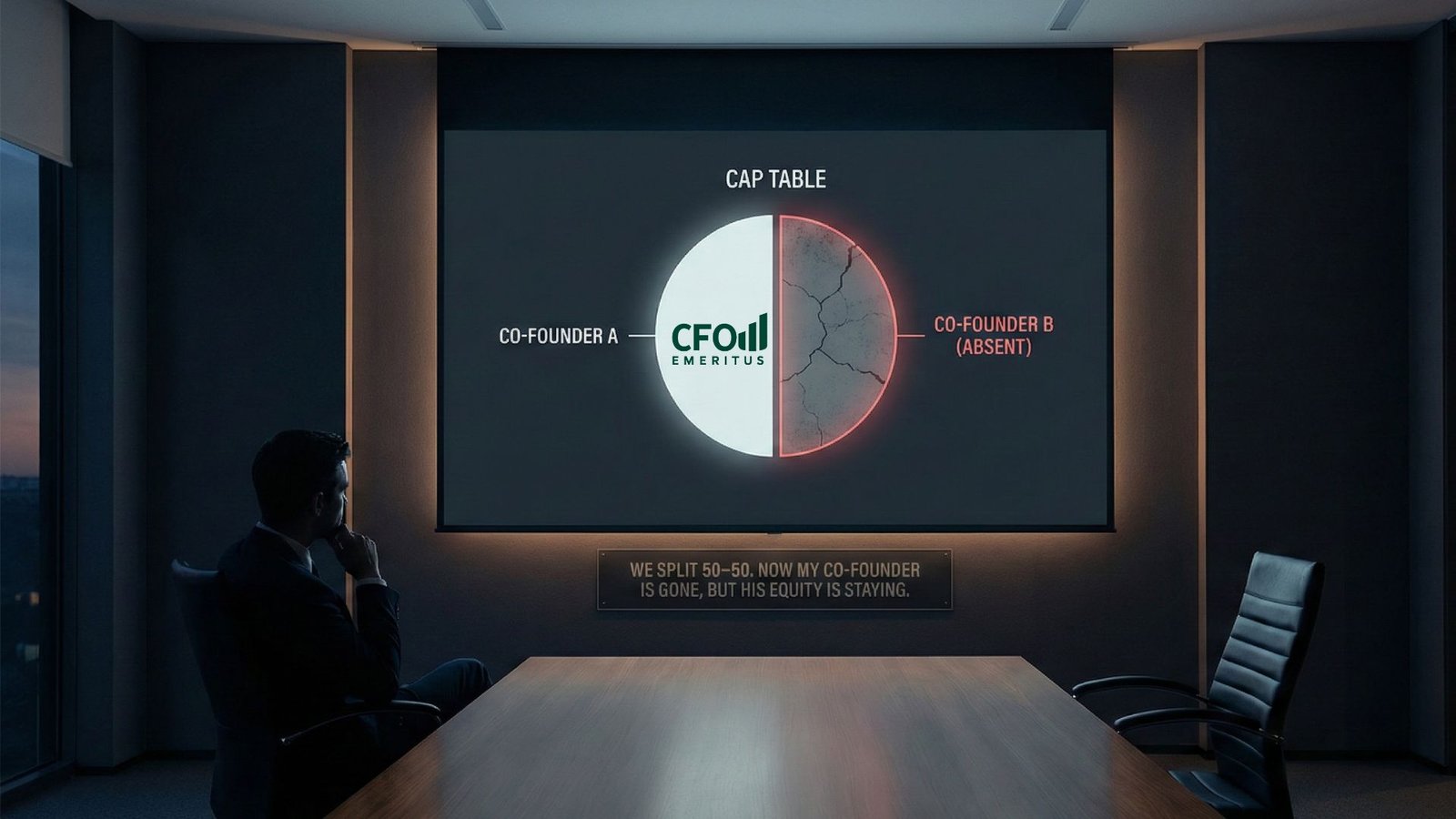
But every time he sent his Cap Table to a VC, they went silent. When we looked at the structure, the problem was obvious.
He was stuck in the “Dead Equity” Trap.
📉 The Real-Life Scenario
Two years ago, this client started his company with a college friend. They split the equity 50-50 on Day 1 because it felt “fair.”
For the first 6 months, everything was great. Then, life happened. His co-founder got a high-paying job offer and decided startup life wasn’t for him. He left the operations completely.
The Problem? He kept his 50% equity.
Now, my client is working 14 hours a day, driving 100% of the growth. But every rupee of value he creates, half of it goes to someone who isn’t there.
This creates resentment. But worse, it created a “Zombie Cap Table.”
🛑 Why Investors Ran Away
When VCs saw the Cap Table, they saw a CEO with only 50% equity, carrying a “sleeping partner” with the other 50%.
To an investor, that equity is “Dead Weight.” They want their money to incentivize the people building the future, not rewarding the people who started the past. They simply cannot invest in a company where half the motivation is missing.
🛡️ The Fix: A “Prenup” for Founders (Vesting)
We advised the founder on how to restructure, but it was a messy, expensive legal negotiation to buy back that equity. It could have been avoided with one document on Day 1.
If you are starting up, you need a Shareholders’ Agreement (SHA) with a Vesting Schedule.
Here is how it works: You don’t get your 50% on Day 1. You earn it over 4 years.
-
The Cliff (1 Year): If a co-founder leaves within the first 12 months, they leave with 0% equity.
-
The Vesting (Monthly/Quarterly): After the cliff, equity unlocks slowly (e.g., 2% every month).
If the co-founder had left in Year 1 under this agreement, the active founder would still control 100% of the company.
🎯 Final Thought
Equity is not a “Thank You” card for friendship. Equity is fuel for the long journey ahead.
If you give it all away at the start line, you will have nothing left to pay for the journey.
At CFO Emeritus, we often help founders clean up messy Cap Tables before they speak to investors—but the best fix is always prevention.
📩 Starting a business with a friend? Don’t let a handshake ruin the business. Get a structure that protects both of you. Write to us at office@cfoemeritus.com